Mink-mink harpy: Difference between revisions
NeonWabbit (talk | contribs) Tags: Mobile edit Mobile web edit Advanced mobile edit |
NeonWabbit (talk | contribs) Tags: Mobile edit Mobile web edit Advanced mobile edit |
||
| Line 91: | Line 91: | ||
Immune to toxins found in plants and bugs they consume, as their bodies can naturally store these toxins in a specialised sac beneath their gallbladder, if ingested. Lifeforce energy can be spent to further neutralise the toxin before they re-enter circulation through the body. While harmless to the harpy, these toxins render their raw meat and blood poisonous to other species. Proper cooking is theorised to neutralise these effects. | Immune to toxins found in plants and bugs they consume, as their bodies can naturally store these toxins in a specialised sac beneath their gallbladder, if ingested. Lifeforce energy can be spent to further neutralise the toxin before they re-enter circulation through the body. While harmless to the harpy, these toxins render their raw meat and blood poisonous to other species. Proper cooking is theorised to neutralise these effects. | ||
==== | ==== Reproduction and hybridisation ==== | ||
Mink-mink harpies are physically compatible with every species, and those that mate with members of a different species produce hybrids that mix elements from both parent species. The hybrid offspring that result from this are also fertile and compatible with every species, leading to further hybridization if the species continue to mix. | Mink-mink harpies are physically compatible with every species, and those that mate with members of a different species can produce hybrids that mix elements from both parent species. The hybrid offspring that result from this are also fertile, and compatible with every species, leading to further generations of hybridization if the species continue to mix. | ||
==== Fur and feather patterns ==== | ==== Fur and feather patterns ==== | ||
Revision as of 14:13, 14 December 2025
| Mink-mink harpy | |
|---|---|
| A NeonWabbit-owned semi-closed race | |
| First appearance | 2018* |
| Created by | SilveroGhost |
| Adapted by | NeonWabbit |
| In-universe information | |
| Other name(s) | minks, harpies |
| Home world | Minkhar Island, Isles of Topaktan, Alternate Earth F |
| Type | Humanoid feline harpy |
| Sub-races | Mink-mink dragons (hybrids) |
| Distinctions | antennae on ears, four wing arms, spikes on tails, avian / feline / primate (especially lemurs) fur patterns |
| Notable members | Frie |
Mink-mink harpies are a semi-closed species owned by NeonWabbit, originally created circa 2018, by an artist using the alias "SilveroGhost". NeonWabbit later purchased the entire species from them in September 2022 for $60 USD.
The first mink-mink harpy character created by NeonWabbit prior to owning the species was Frie. As they were a fully closed species at the time, this was possible through a contest to create fanart of SilveroGhost's mink-mink harpy character Koit, where the major prize was the allowance for contest winners to design their own mink-mink harpies.
While many other mink-mink harpies were also created by the species' original creator, and other contest winners, most of them have been lost to time, and currently only Frie and further characters created by NeonWabbit after his acquisition of the species are considered canon within Studio RGB-Newt / The Fishal Project productions and universes.
The species is now considered semi-closed as fan-made mink-mink harpies are mostly allowed to be freely created for non-canon fanart purposes, if not changing or adding to the lore and design restrictions. Hybrids are also allowed, and this paves the way for Frie's future children with the wingless dragon Flye, spawning the mink-mink dragon sub-species.
Design
Conception
The original SilveroGhost concept of the species was just to simply mix avian harpies with feline and primate characteristics. Chosen additional staples also include their stubby three fingers, multiple limbs/wings, and ear antennae.
Ownership change
In September 2022, ownership of the species transferred to NeonWabbit. Following this acquisition, the canon surrounding the species was streamlined to fit more into the Flye 'n' Frie franchise, with only some of SilveroGhost's original lore retained.
Redesign
After the ownership change, subtle refinements were made to the species' visual language to better align with Studio RGB-Newt / The Fishal Project aesthetics, while preserving most of the original core traits.
One major change is specifically the nose, and how it comes out like a human's, but has a leathery feline button nose at the bottom.
Attributes
Biology
Body and tail
Much like other harpies, mink-mink harpies have a bipedal humanoid build. Unlike traditional harpies with bird-like feet though, their lower-half is more feline, and with a long, thick prehensile tail. On females only, this tail has sharp spike protrusions, made of bone and coated with hardened keratin. They can use these spikes to defend themselves against predators, egg thieves, and other hostile creatures.
Females are also generally taller than the males of the species, but are themselves still a bit short (or of equal height) compared to species of similar build, such as kobolds, or other bipedal dragons.
Arms, hands, and wings
Every mink-mink harpy has two sets of wing arms. Their larger primary set, is positioned where they are usually expected on humanoids, and their smaller secondary set of arms differs by sex of the character: males have dorsal wings on their tail, without any hands, while females have a fully-functional set of wing arms with hands, on the sides of their body underneath their larger set of wing arms, and in-line with their belly button.
Their forearms are highly adapted for flight, combining strong, dense muscle with hollow bones. Thick, bendable, and waterproof feathers cover the entire underside of the arms. All feathers can be reabsorbed by magic into the arms, concealing them, at the cost of flight. The feathers can be re-summoned out instantly, by expending lifeforce energy, or they can also slowly grow back over time.
Hands consist of two fingers and an opposable thumb on each hand, tipped with retractable claws. Their ring and pinky finger bones are fused with the primary feather of their wings, enhancing durability and fine control in flight, particularly within the dense forest canopies they usually inhabit. Female mink-mink harpies can use their lower arms to carry items and/or even other people around whilst flying, or simply for aiding in activities such as rock climbing.
Ears and antennae
Their ears are feline-like, matching their legs, with a patch of inner ear fluff at the base.
Antennae located at the tip of their ears enhance sensory perception, allowing mink-mink harpies to detect which direction sounds and sonic frequencies are coming from, measure wind speed, and interpret other weather-related phenomena.
Habitat preference
Mink-mink harpies favour tropical climates and rainforest environments. Mink-mink harpy populations native to these areas, such as those on the aptly-named Minkhar Island, face extinction due to increased deforestation.
Toxins and immunity
Immune to toxins found in plants and bugs they consume, as their bodies can naturally store these toxins in a specialised sac beneath their gallbladder, if ingested. Lifeforce energy can be spent to further neutralise the toxin before they re-enter circulation through the body. While harmless to the harpy, these toxins render their raw meat and blood poisonous to other species. Proper cooking is theorised to neutralise these effects.
Reproduction and hybridisation
Mink-mink harpies are physically compatible with every species, and those that mate with members of a different species can produce hybrids that mix elements from both parent species. The hybrid offspring that result from this are also fertile, and compatible with every species, leading to further generations of hybridization if the species continue to mix.
Fur and feather patterns
Mink-mink harpy fur and feather patterns have been observed to resemble those of any avian, feline, or primate (such as lemurs), regardless of their birth location. They are capable of having rare genetic mutations, such as being born with even more wings or more tails, black sclera eyes, and/or be born "feral", meaning no humanoid skin is visible, with fur and feathers covering up the entirety of their human-like parts instead. With enough lifeforce energy, mink-mink harpies who weren't born feral can switch between feral and humanoid forms.
Culture
Food
A native mink-mink harpy's diet consists of fruits, plant nectars, nuts, seeds, insects, and insect byproducts, such as honey. A mink-mink harpy in more civilized areas might actively seek out normal human food, such as meats, and prepared meals like sushi, but it is recommended by the elders of mink-mink harpy clans that they should eat some of their native diet on occasion, for a healthy balance of sugars and nutrients.
In the past, mink-mink harpies themselves were poached, as they used to be killed for their feathers, meat, and eggs.
Social life and family
They are highly sociable creatures, and tend to flock together with others that share their animal-kind, be it avian, feline or primate. They also get along well with reptiles, including dragons, as they are similar to avians, both having claws, and the ability to lay eggs, for example.
Native mink-mink harpy villages and clans are usually lead by the eldest flock, that is, the flock which has the highest number total when all ages of the members are added together, and this can include other species who have decided to join and have been accepted into the flock. They are not jealous or experience other negative emotions when flock members defect to another flock, and for mating purposes, this is usually encouraged, as members of a flock are expected to mate with those of a different flock.
The native mink-mink harpy courtship ritual involves the male building and decorating a suitable nest bed for the process, and putting on a showcase of their feathers, fur, and physical abilities in unique song and dance. The female watches from a distance, and if they remain for the entire duration of the display, they are presented with a gift, ranging from shiny and colourful objects to food.
The couple then begin to get to know each other over a period of months, mutually taking turns defending the territory, preening each other, and keeping watch at night. Eventually, they will each pluck their most pristine feather out of their own body and trade it with their partner, braiding their swapped feathers into each other, signifying they are fully bonded. Mink-mink harpies mate for life, perform yearly anniversary rituals, and do not take on a new mate after the death of their mate.
Infertile mink-mink harpies, or those looking to adopt, will accept orphaned chicks or runts from any flock that has them. Mink-mink harpies can lay between 1-5 eggs per season, and both the male and female will take turns to incubate and raise the young, once hatched.
It is extremely rare for mink-mink harpies to ever be alone as they make friends easily, due to their curious nature, and they don't have any natural predators or enemies as they are poisonous and can defend themselves with their sharp spikes and claws. They live peacefully and solve disputes by bringing their issues up with the elders of the eldest flock.
Language
Native mink-mink harpy language consists of short chirps, chitters, purrs, coos, and loud screeches of varying lengths, all combined with body language and eye contact. They are also known for their mimicry, as they can easily and accurately repeat sounds from other creatures and objects that they hear, and over a long period of time can learn spoken language. Still, even after getting to the point where they can somewhat communicate with other parties, it takes even longer for them to get out of the habit of bad pronunciation, broken grammar, and messy speech patterns if they were not born in a place where spoken language is the norm.
In-universe biography
Mink-mink harpies used to be hunted by regular humans before an international act was signed into law preventing this from happening any further. They are still critically endangered to the point that it is estimated that there is currently only approx. 1 to 3 mink-mink harpies in each continent of the world, with an outlier exception of entire villages and clans of mink-mink harpies of varying population that populate their own native tropical island, Minkhar.
It became rare for them to leave the island, as early mink-mink harpy explorers, like Frie's ancestors, who moved off the island and closer to advanced civilization sometime in the past, were never heard from again back on the island by those who saw them off.
Notable mink-mink harpies
Appearances
TBA
- Flye 'n' Frie (video game, TBA)
Legacy
Gallery
-
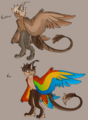 Examples of young male native mink-mink harpies
 -
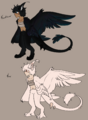 Ditto, but females
.png)
.png)
See also
- Dummys, cyborg insects (especially bees), that can travel into the digital realm.
- Frosteyls
- Gravepine
- Styvers
- List of Flye 'n' Frie background characters
Notes
References
External links
Notable fictional species in NeonWabbit productions | |
|---|---|
| Flagship species |
|
| Minion creatures | |
| Nyah-specific | |
| Other species |
|

